

AI Integration Strategy Built on Structural Intelligence (SIS™)
Enterprise AI adoption for AEC firms grounded in architectural discipline, governance stability, and measurable system integrity.
AI adoption fails when integration lacks structure.
Most organizations implement tools.
Few design systems.
The AI Integration Strategy developed by Salaam Integration Group applies the Structural Intelligence Standard (SIS™) to ensure workflows, governance, and automation architectures remain stable under scale.
This is not experimentation.
It is engineered transformation.
The AI Gap Is Already Costing You
In 24 months, there will be AI-powered firms and everyone else. Which will you be?

Competitive Disadvantage
Firms implementing AI now are winning proposals, delivering faster, charging more.

Talent Drain
Top engineers want to work with cutting-edge tools. Legacy firms lose them.

Margin Erosion
Manual processes that AI could handle = hours billed at lower margins.

Why AI Integration Fails (And How We Ensure It Doesn't)
AI Failure Is a Structural Problem
Organizations typically experience:
- Workflow fragmentation
- Automation redundancy
- Governance gaps
- Knowledge decentralization
- Performance instability
These failures occur because systems are implemented without structural validation.
SIS exists to prevent this.
The Phillip Salaam Approach:
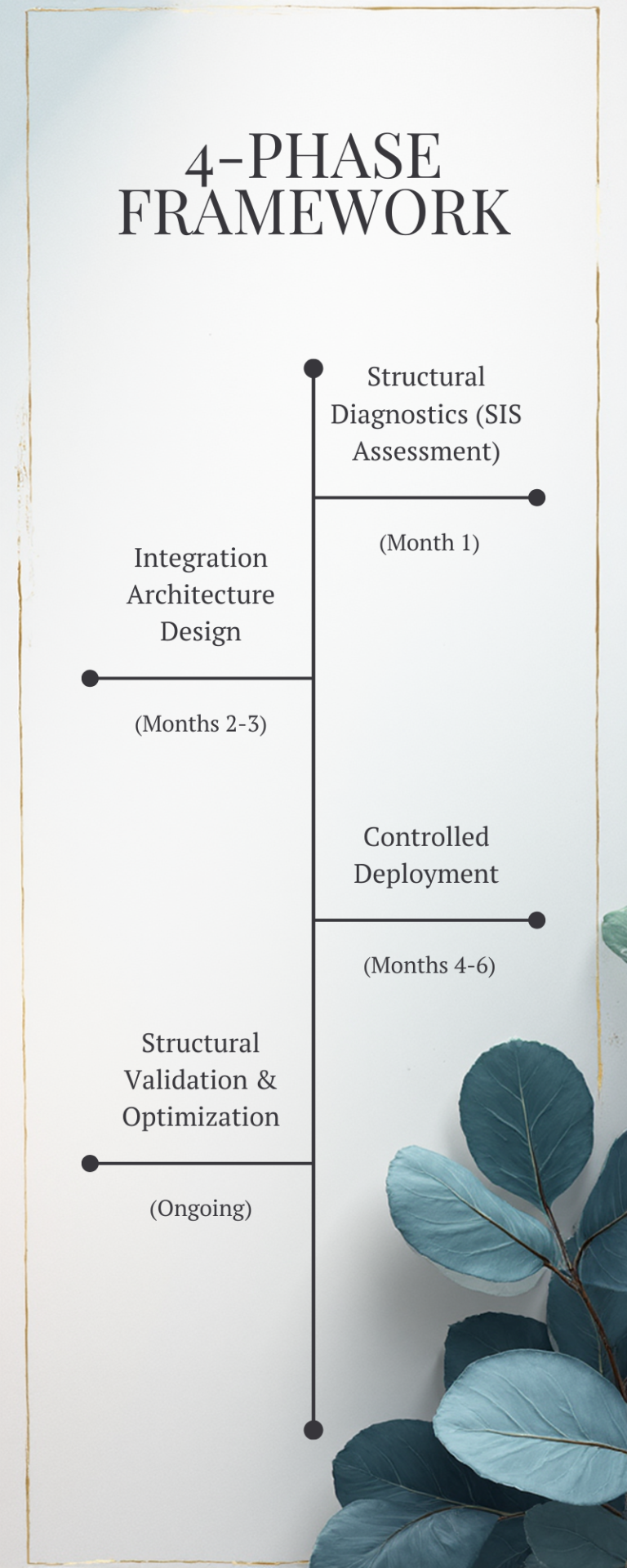
4-Phase Framework
- Structural Diagnostics (SIS Assessment) (Month 1)
- Workflow audit
- Team capability assessment
- ROI projection modeling
- Custom AI roadmap
- Deliverable: 40-page strategic implementation plan
- Integration Architecture Design (Months 2-3)
- Prompt engineering training
- Tool selection & integration
- Pilot project identification
- Internal champion development
- Deliverable: Trained core team + pilot launch
- Controlled Deployment (Months 4-6)
- Workflow integration
- Quality control systems
- Efficiency measurement
- Scaling protocols
- Deliverable: Operational AI workflows + metrics dashboard
- Structural Validation & Optimization (Ongoing)
- Competitive differentiation
- Client-facing AI capabilities
- Thought leadership positioning
- RFP enhancement
- Deliverable: AI-forward market presence
Our Unique Advantage: "I've spent 15+ years as a practicing civil engineer. I know your CAD standards, your submittal processes, and your client expectations. This isn't theoretical—it's a practical transformation from someone who's lived your challenges. This methodology integrates civil engineering systems thinking with Structural Intelligence research."
Learn more about the Structural Intelligence Standard (SIS)™
Why Structural Intelligence Standard (SIS)™?
Because if the structure fails, everything fails.
SIS is the foundation of our integration methodology.
Measurable outcomes:
Organizations typically achieve:
- 30–100% workflow efficiency improvement
- Reduced coordination delays
- Improved documentation quality
- Increased billable utilization
The Structural Intelligence (SIS™)–driven framework measures and optimizes architectural integrity across engineered systems, narrative structures, and AI outputs using metrics such as alignment stability, coherence integrity, and scalability under load.
Organizations typically achieve measurable outcomes, including 30–100% improvements in workflow efficiency, reduced coordination delays, higher documentation quality, and increased billable utilization, through structurally validated processes.
Choose Your Engagement Level

AI Readiness Assessment
- Investment: $6,500 (one-time)
- Timeline: 2 weeks
What This Engagement Provides:
A structured evaluation of your organization’s current AI integration maturity using principles aligned with the Structural Intelligence framework.
This assessment identifies where AI can create a measurable impact while minimizing operational disruption and implementation risk.
Scope Includes:
- Workflow architecture analysis
- Team capability and readiness evaluation
- Technology and automation gap assessment
- Structural risk and dependency review
- Custom AI integration roadmap
- 90-minute executive strategy presentation
Outcomes
Organizations leave with:
- Clear implementation priorities
- Identified quick-win opportunities
- Risk awareness before scaling
- A structured path toward measurable ROI
Best Suited For
Engineering and construction firms that:
- Are evaluating AI adoption
- Want clarity before investing heavily
- Need leadership alignment
- Are not yet ready for full implementation
This assessment is designed to replace months of internal experimentation with a focused, architecture-driven roadmap.
Foundation Program
Structured AI Pilot & Implementation
- Investment: $9,500/month
- Minimum Engagement: 3 months
The Foundation Program moves your organization from assessment into controlled implementation.
Using Structural Intelligence (SIS™) principles, this phase focuses on pilot deployment, team capability development, and workflow alignment to ensure early AI adoption delivers measurable operational value without disruption.
Included Components
Everything in the AI Readiness Assessment, plus:
- Team training in applied AI workflows and prompt architecture
- Tool selection and procurement guidance aligned with operational needs
- Pilot implementation planning and support
- Monthly executive strategy and progress sessions
- Workflow integration coaching for core team members
- Ongoing advisory access (email / Slack support)
Outcomes
Organizations typically achieve:
- Successful pilot implementations within existing workflows
- Measurable efficiency improvements in targeted processes
- Increased team confidence and adoption readiness
- Reduced experimentation risk through structured deployment
- A validated foundation for enterprise-scale integration
Best Suited For
Engineering and construction firms that:
- Are you ready to begin AI pilots
- Want guided implementation rather than trial-and-error
- Need team training alongside strategy
- Intend to scale AI adoption after early success
This phase transforms AI from concept into operational capability. It replaces fragmented experimentation with structured, architecture-driven implementation.

Full Transformation Partnership
Enterprise AI Integration & Structural Implementation
- Investment: $13,800/month
- Minimum Commitment: 6 months
Engagement Overview
The Full Transformation Partnership is a comprehensive integration program designed for organizations committed to embedding AI into core operations, service delivery, and market positioning.
Building on the Foundation phase, this engagement applies Structural Intelligence (SIS™) principles to redesign workflows, implement quality controls, and establish scalable AI capabilities that give the firm a competitive edge.
The objective is not pilot success — it is institutional capability.
Included Components
Everything in the Foundation Program, plus:
- Custom workflow integration across priority operational areas
- Structural quality-control and validation system design
- Governance architecture for sustainable AI adoption
- Client-facing AI capability development and implementation
- Strategic market positioning guidance aligned with AI differentiation
- Weekly implementation and leadership alignment sessions
- Priority advisory access and implementation support
Outcomes
Organizations completing this phase typically achieve:
- Embedded AI workflows across multiple operational domains
- Measurable productivity and efficiency improvements
- Reduced operational friction and redundancy
- Institutional AI competency within the team
- Competitive positioning as an AI-enabled engineering firm
- Scalable systems capable of long-term growth
Best Suited For
Engineering and construction firms that:
- Are committed to becoming AI-enabled organizations
- Intend to lead rather than follow industry adoption
- Want structured transformation instead of incremental change
- Require executive-level implementation guidance
This partnership establishes AI as operational infrastructure — not a toolset.
It integrates architecture, governance, and capability development into a unified system designed to perform at scale.
Early Partner Opportunity
The first three organizations entering this partnership will receive a complimentary strategic market positioning case study documenting transformation outcomes and competitive advantages.
Engagement Note
Transformation partnerships are intentionally limited to maintain implementation quality and executive attention.

The AI Transformation Blueprint
Enterprise AI Integration & Structural Intelligence Partnership
- Investment: $470,052 Annually ($39,171/month)
- Engagement Duration: 12–36 Months
Executive Overview
The AI Transformation Blueprint is a comprehensive enterprise engagement designed to embed artificial intelligence into the operational architecture, workflows, and competitive positioning of engineering and construction organizations.
This partnership moves firms beyond experimentation into institutional capability.
Using Structural Intelligence (SIS™) principles, we work directly with leadership and operational teams to design, implement, validate, and scale AI-enabled systems that deliver sustained productivity gains, governance stability, and long-term strategic advantage.
By the end of the first year, organizations typically operate with significantly higher efficiency, improved access to knowledge, and internal teams capable of maintaining and evolving AI systems independently.
Scope of Engagement
The Blueprint combines consulting, implementation, training, and strategic development into a unified transformation program.
Core Components Include:
- 120 hours of dedicated consulting and implementation leadership
- 36 structured training sessions across departments (group and individual)
- Development of a proprietary prompt architecture library (150+ workflow-specific assets)
- Design and deployment of 1–2 custom AI tools aligned with operational needs
- Unlimited advisory access via email / Slack with priority response
- Monthly ROI and performance analytics reporting
- Quarterly executive briefings with strategic planning guidance
- Department leadership workshops (four half-day intensive sessions)
- Two on-site implementation visits during critical phases
- Internal AI Champion certification for 3–5 staff members
- Complete AI operations documentation and governance manuals
- Year-two strategic roadmap and scalability plan
- Conference participation advisory support (up to three events annually)
- Priority response for critical operational issues
Structural Intelligence Integration
All implementation phases are guided by the Structural Intelligence framework, ensuring:
- Workflow alignment stability
- Knowledge architecture coherence
- Governance integrity
- Operational scalability under load
- Risk mitigation during adoption
This architectural discipline differentiates the Blueprint from typical AI consulting programs.
Expected Outcomes
Organizations completing the first year commonly achieve:
- Significant productivity and efficiency improvements across workflows
- Reduced operational friction and coordination delays
- Institutional AI competency across departments
- Custom automation assets owned by the organization
- Improved knowledge accessibility and decision support
- Competitive differentiation in the marketplace
- Scalable systems capable of long-term growth
Ideal Organizations
This engagement is best suited for:
- Engineering and construction firms with 30–150+ employees
- Organizations generating $5M+ annually
- Leadership teams comare mitted to operational transformation
- Firms managing repeatable project workflows suitable for automation
- Market leaders seeking competitive differentiation through AI capability
- Companies are ready to invest internal time and change management effort
- Organizations committed to a structured, multi-month journey
Not Recommended For
- Firms under 20 employees
- Leadership is skeptical of AI adoption
- Organizations seeking immediate results without internal participation
- Companies unware illing to evolve established workflows
Industry Leadership Bonus Package
Included with 12-Month Commitment
Organizations entering the full Blueprint engagement receive additional strategic benefits designed to strengthen market positioning and industry visibility.
Included Benefits:
- Co-authored a transformation case study published across platforms
- Conference presentation development support (deck, narrative, rehearsal)
- Marketing content bundle including thought leadership and client materials
- Competitive intelligence reporting on industry AI adoption trends
- Early access to emerging tools and methodologies
- Alumni peer network participation with other transformation partners
- Extended advisory support during transition period (Months 13–14)
Engagement Philosophy
The Blueprint treats AI as operational infrastructure — not a collection of tools.
Architecture precedes automation.
Governance precedes scale.
Capability precedes independence.
The objective is institutional transformation that continues delivering value long after the engagement concludes.
Availability
Transformation partnerships are intentionally limited to maintain implementation quality and executive attention.
Real Transformation: Ring of Excellence
Client: Ring of Excellence (Design Firm, Baytown, TX)
Challenge:
- Needed competitive differentiation in a crowded market
- Manual processes are limiting growth
- Team is uncertain about AI capabilities
Solution:
- Comprehensive AI integration strategy
- Custom workflow redesign
- Team training program
- Market positioning overhaul
Results:
- Positioned as AI integration leader in the Houston AEC market
- 40% reduction in preliminary design time
- Team confidence in AI tools increased from 30% to 85%
- Enhanced proposal win rate with AI-powered capabilities 25%
Testimonial:
Common Questions
Q. Our team is already overloaded. How do we add AI implementation?
That constraint is exactly why structured integration matters.
Most AI initiatives fail because organizations attempt to layer tools onto already strained workflows. The SIS-driven approach reduces long-term workload by eliminating redundancy, improving knowledge access, and streamlining repetitive tasks.
We handle architecture, prioritization, and training design. Your team focuses only on targeted pilot applications that generate measurable efficiency gains.
The objective is not to add work — it is to remove friction.
Q. What if AI doesn’t work for our specific workflows?
Engineering workflows are highly constrained by standards, liability considerations, and coordination dependencies.
With over fifteen years of civil engineering experience, the integration approach begins with low-risk, high-value applications such as:
- Proposal development
- Preliminary analysis support
- Documentation automation
- Code and standards research
Only after measurable success do we expand into more complex workflows.
This phased approach minimizes risk while validating ROI early.
Q. Can’t we figure this out internally?
Many firms attempt internal experimentation first.
The typical result is:
- Tool fragmentation
- Inconsistent training
- Workflow disruption
- Minimal performance improvement
Six to twelve months later, organizations seek external architecture guidance.
Structured integration dramatically compresses the learning curve, allowing firms to reach stable implementation much faster and with lower risk.
Q. What is the time commitment for our team?
Time investment is intentionally designed to be manageable.
Assessment Phase:
Approximately 5–10 total leadership hours.
Pilot Implementation Phase:
~2 hours per week for the core implementation team.
Scaling Phase:
Integrated into existing workflows with minimal disruption.
The objective is operational alignment — not additional workload.
Why This Approach Works
AI integration is not primarily a technology problem.
It is a structural problem.
The methodology applied here combines:
- Civil engineering systems thinking
- Enterprise workflow architecture
- Structural Intelligence Standard (SIS™) validation
- Practical implementation experience
This combination ensures solutions remain stable under operational scale.
Experience Foundation
15+ Years — Civil Engineering Workflow Experience
Experience across multiple AEC environments and project types.
Structural Intelligence Research & Development
Creator of the Structural Intelligence Standard (SIS™).
Multi-Domain Implementation
Daily application of AI tools across engineering, writing, and business operations.
Professional Credentials
EIT, ENV-SP
Teaching & Speaking
Programs in development.
Implementation Assurance
After completing the AI Readiness Assessment, organizations receive a clear roadmap outlining expected efficiency gains and implementation priorities.
If the assessment does not identify a credible pathway to a substantial ROI within 12 months, the assessment fee will be refunded.
The goal is measurable transformation — not experimentation.
The AI Adoption Window
AI adoption across engineering and construction is accelerating rapidly.
2023 — Innovators2024 — Early Adopters2025 — Early Majority
2026 — Late Majority ← Majority of organizations are entering this phase now
2027+ — Full Industry Saturation
The competitive advantage window exists before adoption becomes universal.
Organizations that integrate early develop institutional capability and workflow maturity that competitors cannot easily replicate.
Engagement Availability
AI integration engagements are intentionally limited to maintain implementation quality and executive attention.
Current capacity supports a small number of new organizations per quarter.